
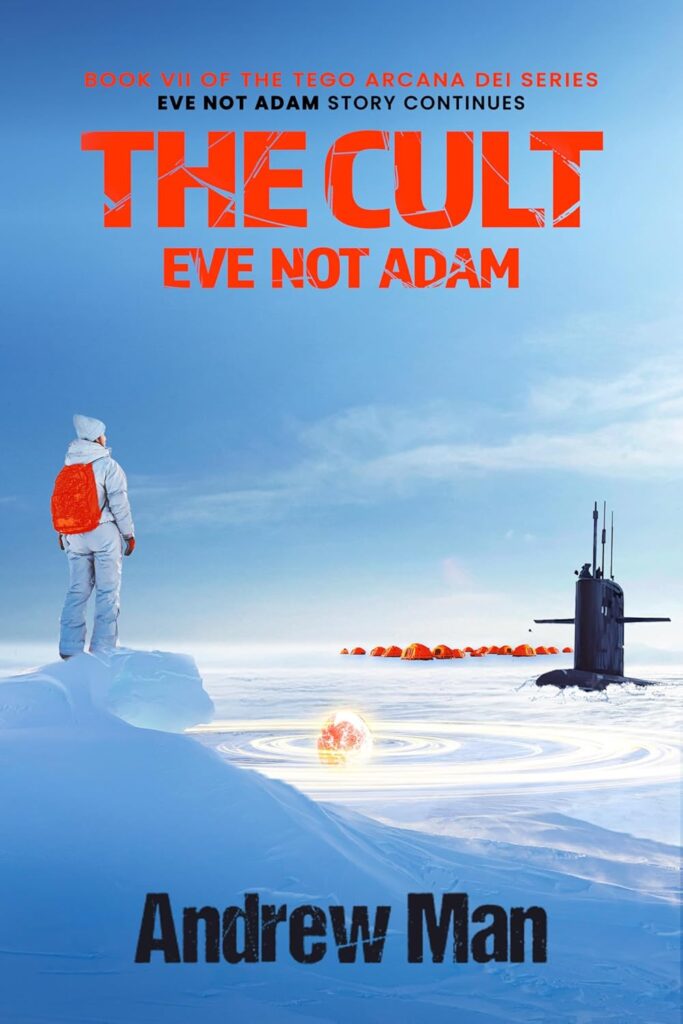
By Andrew Man
In THE CULT: Eve Not Adam, the seventh and final installment of the Tego Arcana Dei series, Andrew Man delivers a high-stakes techno-political thriller that deliberately blurs the boundary between speculative fiction and contemporary unease. Set across the first six months of 2024, the novel brings together time travel, geopolitical tension, and science-fiction elements to interrogate power, belief, and the narratives societies choose to accept as truth.
The story follows James, a pilot who escapes an apocalyptic future by returning to a Caribbean island in 2024 with a narrow window to prevent global catastrophe. What initially appears to be a straightforward race against extinction quickly expands into a complex web of political manipulation, emerging technologies, and hidden authority structures. Parallel to James’s mission, British Marine Justin Benbow’s reassignment in London draws him into a maze of force fields, covert operations, and unexplained phenomena, grounding the novel’s larger themes in personal consequence and moral uncertainty.
Man’s greatest strength lies in his ability to sustain tension across multiple fronts. Volcanic instability, a mysterious black box, the arrival of an alien craft, and the appearance of scientists from the future are introduced with measured pacing rather than spectacle. These elements function less as gimmicks and more as catalysts, forcing characters to confront uncomfortable questions about agency, governance, and responsibility. The recurring motif of “free energy” and concealed agendas reinforces the book’s central concern: who controls the future, and at what cost?
Stylistically, Eve Not Adam favors clarity over excess. The prose is direct and purposeful, allowing the conceptual weight of the narrative to carry the tension. Man resists the temptation to over-explain, trusting readers to navigate the ethical implications themselves. His decision that the novel remain explicitly fictional—despite drawing inspiration from real-world political anxieties—adds to its credibility, framing the work as a thought experiment rather than a manifesto.
As the concluding entry in the series, the novel benefits from accumulated momentum. Long-running ideas reach a point of synthesis, and while not every mystery is resolved neatly, the ambiguity feels intentional. The result is a finale that prioritizes reflection over closure, asking readers to sit with discomfort rather than offering easy answers.
Verdict
THE CULT: Eve Not Adam is an ambitious and intellectually provocative conclusion to the Tego Arcana Dei series. Readers who appreciate speculative thrillers that engage with political, technological, and philosophical themes will find this novel compelling. Andrew Man closes his series with restraint and confidence, delivering a story that challenges assumptions and invites interpretation long after the final page.